Whatever your
imagination has created, the image has something
different.
Images are not
general. They represent individuals, that is, single things.
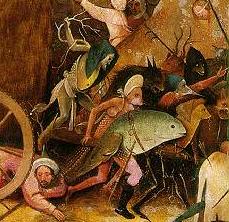
Such things can be imaginary, like in this particular from Hyeronimus
Bosch's "Haywain":
Yet, they have
particulars, whereas symbols are general descriptions, which
tell us how to build a mental image but allow a great deal of freedom
in particulars. Middle age philosophers called such 'particulars' the
'contingent', that is, what can vary without changing the
concept.
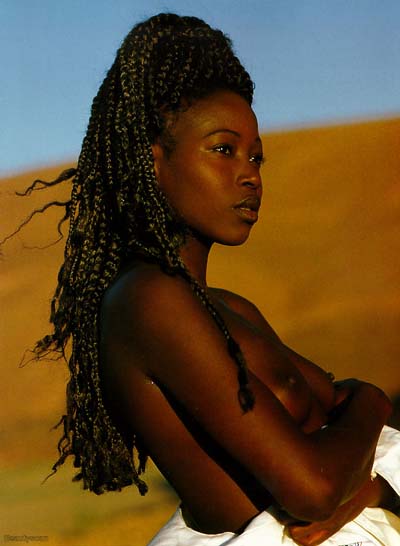
In fact, also the
following image is "a beautiful black woman".

I think that
the 'contingent' is the internal character of an image which makes us
think that the image is true. The 'contingent' is not
predictable, because it is not implied in the concept, it cannot be
easily imagined. It shows the presence of experience, the indexical
character of the image: the world of individual and contingent facts,
rich of infinite particulars, too many to be kept in mind.
The indexical
image has some characters of experience. And experience is always
richer that the concept, since concepts are instructions to build
mind images with a lot of gaps that can be filled as we
like.
Take the following
photograph:
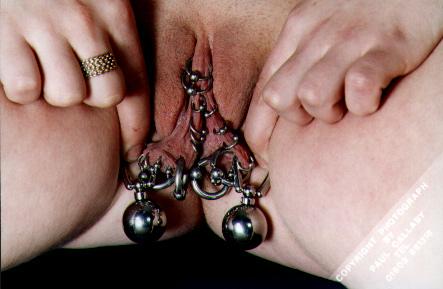
The load of
metal is so excessive to be hardly believable if verbally described.
It will be very difficult to imagine the particulars if you are not
an expert in piercing.
Such a presence of
contingent is an index of truth in images.
The contingent is
even more when the photograph reports an ongoing event:
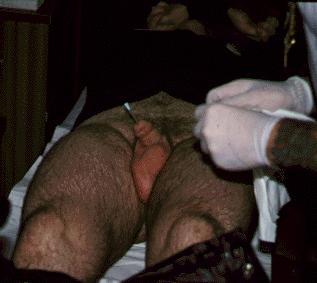

(the insertion of a "Prince Albert", a particular kind of male genital piercing)
A more sophisticated photograph. like this:
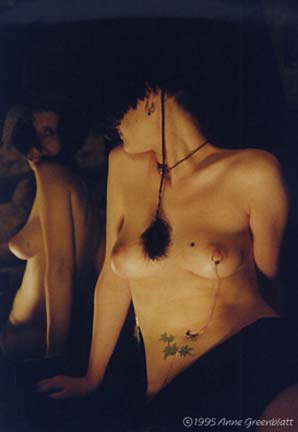
gives a lesser feeling of truth.
Thus, I think
that the 'degree of contingent' is the most important internal
character which lets us infer that an image is an index, i.e., that
it is the effect of the real event which it represents.
Of course, the
inference can be wrong, and the image can be completely artificial or
synthetic. Or it can be retouched (roughly, indeed), by changing some
pixels:

But
cancelling is easier than creating. The load of contingent does
not change very much.
Reality, the
experience, the contingent, are not surprising because we find in
them macro-events that are difficult to invent or imagine (piercing
is among them), but because it is filled with micro-events, a texture
of small deformities, individualities, imprecisions, which cannot be
produced by any synthetic imagination.
We understand, then, Japanes art, which does not aim to the concept, like classic western art, but is amazed by the contingent, and has a kind of painting whose main subject is just bamboo leaves. It is called sumie. In representing the leaves, the artist tries to imitate the absolutely casual way in which they are placed in nature. That is, contingency.
These
reflections can help us in answering the question whether, in the
time when any image can be synthesized, it still makes sense to talk
of photography. The answer is 'yes', since what we find in
photography is not 'inside' the text, but comes from our natural need
to know reality.
Giampaolo
Proni september 1997 - november 1998
http://www.infotel.it/fabula/n-gpr.htm